

In the rapidly evolving landscape of enterprise technology, I often hear a debate: Do we need the structured reliability of Process Automation, or the adaptive intelligence of AI Agents?
The truth is, choosing one over the other is a false dichotomy. The real “North Star” for modern operations is the combination of reliable, deterministic business workflows with the fluid flexibility of AI agents. Together, they form the foundational architecture of what we now call Agentic Workflows.
In this architecture, the AI agent acts as the “Cognitive Front-End”—understanding intent, extracting context, and managing the human interface. Meanwhile, the automated workflow serves as the “Deterministic Core”—executing business rules with 100% accuracy, maintaining audit trails, and connecting to your systems of record.
Driving a truly modern business requires the integration of both cognitive and procedural strengths. To illustrate this synergy, I have designed a “Hello World” experiment: a super simple discount checker that showcases the seamless handshake between these two powerful paradigms.
The role of the workflow
From a business standpoint, the workflow acts as the deterministic anchor. Unlike an AI agent, which is probabilistic and processes intent through a lens of variability, the workflow is stable and rule-driven providing a fixed execution path. This ensures a fundamental business guarantee: that every decision follows the same logic, every single time, without the risk of “hallucination”. In the case of the discount example, this structural integrity ensures several critical outcomes:
- Policy enforcement: The workflow ensures that a discount is only applied if specific, pre-defined business rules are met.
- Accuracy and reliability: A workflow using a Code node or a database lookup will return $50 every single time for a matching policy, ensuring 100% financial accuracy.
- Scalability: Today you check only a policy number; tomorrow, the workflow can be updated to check the customer’s payment history, their age, and their location across different databases simultaneously.
- System of record: By using a workflow, every decision is logged, creating an audit trail that is essential for compliance.
- Decoupling logic from chat: It allows business analysts to change the “discount math” without having to re-adjust the AI model.
- Complexity management and logical guardrails. Ensures that even the most complex ‘if/then’ scenarios remain stable and predictable.
The “Hello world” experiment
To better understand why this architecture is so powerful, we need to look at how these two “partners” divide the work.
| AI Agents | Workflows | |
| Interaction | Understands the user’s “messy” human language and intent. | Doesn’t care about the tone; it only cares about the data (POL-12345). |
| Data handling | Extracts the policy number and maps it to a variable. | Connects to the systems (SQL, CRM etc.) to find the answer. |
| Security | Ensures the user has the permission to ask for a discount. | Ensures the calculation follows the approved companies business rules and specifications. |
Modern business applications need a dual approach: the adaptability of AI and the precision of automation. To demonstrate this “win-win” synergy, I have designed a “Hello World” experiment—a foundational proof-of-concept that showcases the seamless interaction between IBM watsonx Orchestrate (the agentic orchestrator) and n8n (the workflow automation tool). This “Minimum Viable Demo” features a straightforward discount checker to illustrate how these two worlds combine to turn natural language into reliable, deterministic results.
I built a hybrid environment. Both IBM watsonx Orchestrate ADK and n8n were hosted locally on my Mac. The only “bridge” to the cloud was the Language Model —specifically, the default model provided by IBM watsonx Orchestrate (GPT-OSS 120B via Groq). This model acts as the interface, interpreting my requests and delegating tasks to my local n8n workflow via tool calls.
I started by creating a deterministic trigger workflow. The process – outlined in the screenshot below – is lightweight: it captures a policy ID (e.g., POL-12345) from a chat message and instantly applies a business rule to determine the correct loyalty discount which should be awarded. This simple logic serves as a scalable blueprint for more complex tasks, from claims processing to automated renewals.
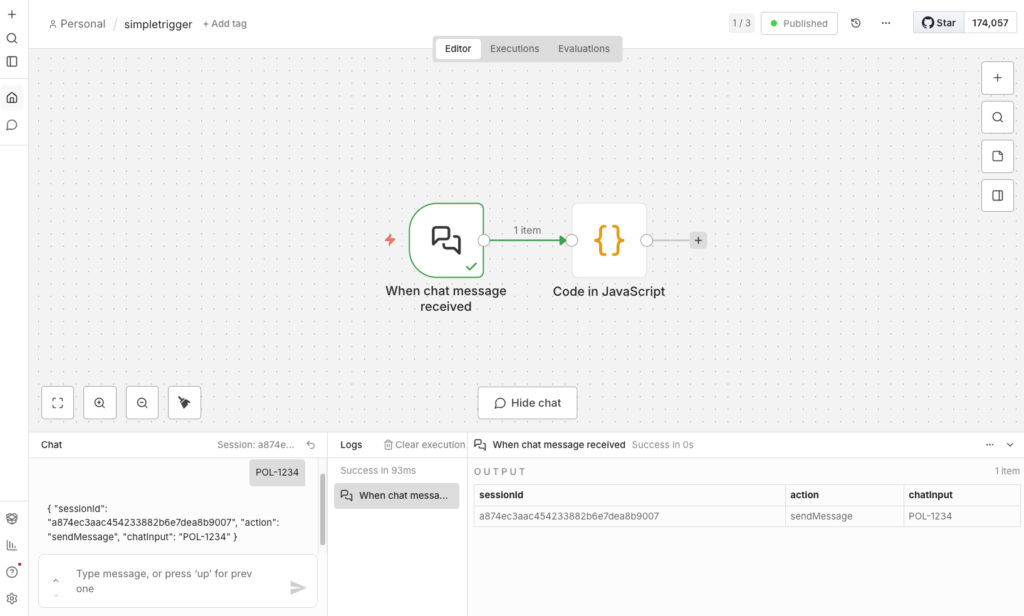
To make use of this flow in IBM watsonx Orchestrate connect the n8n MCP tools via
npx -y supergateway --silent \
--streamableHttp http://host.docker.internal:5678/mcp-server/http \
--oauth2Bearer <n8n token>

There are three tools available
- search_workflows: Returns a preview of each workflow available
- get_workflow_details: Returns the input schema and workflow description
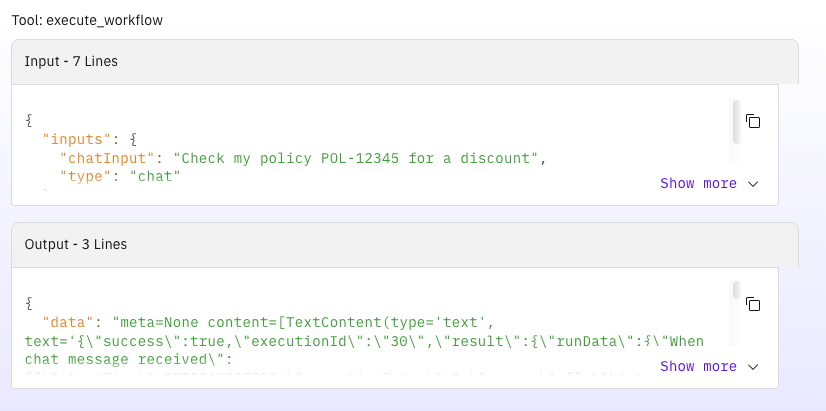
- execute_workflow: Get detailed information about a specific workflow including trigger details
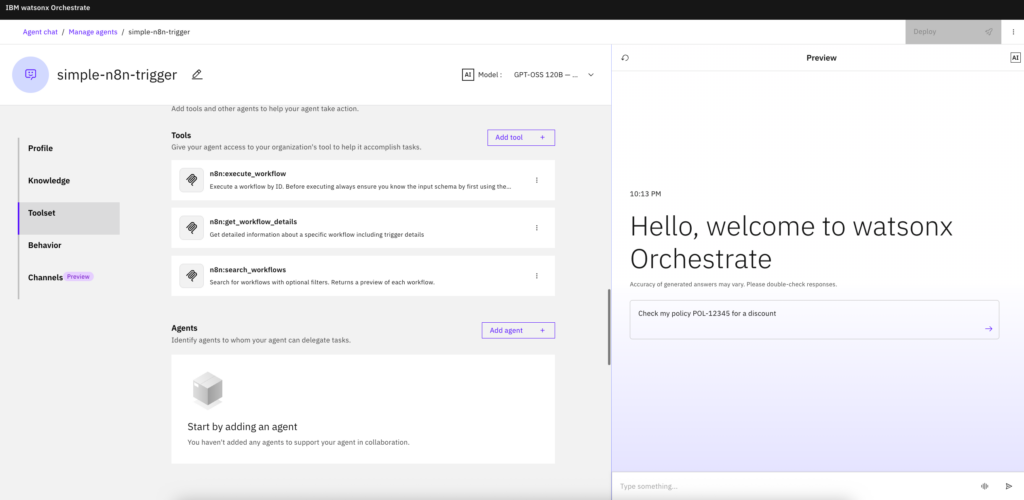
When a user asks, “Check my policy POL-12345 for a discount“, the Large Language Model first extracts the policy ID POL-12345 from the request. It then triggers the workflow described above to determine the discount based on a predefined business rule.
Examining the reasoning steps provides full transparency into how the individual tools are called by the agent:
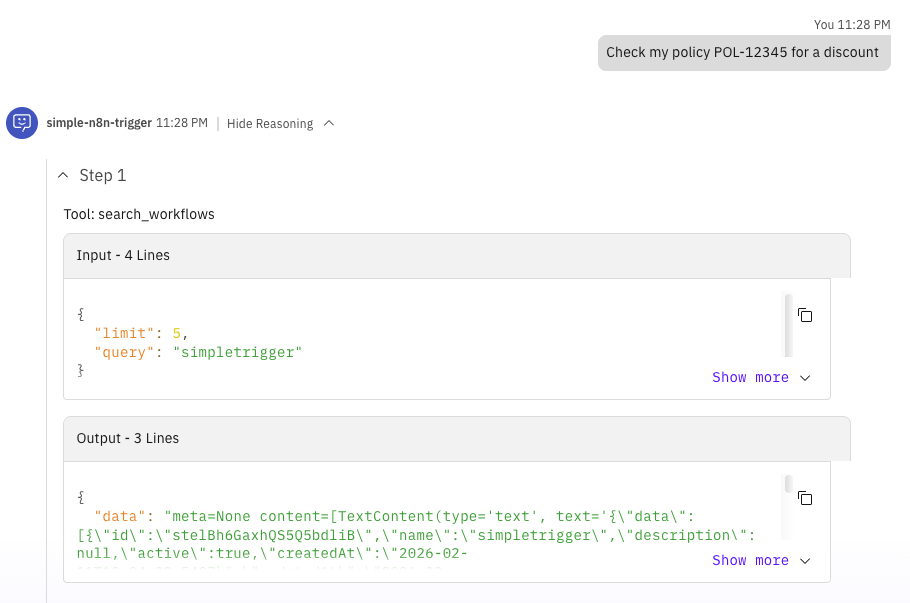
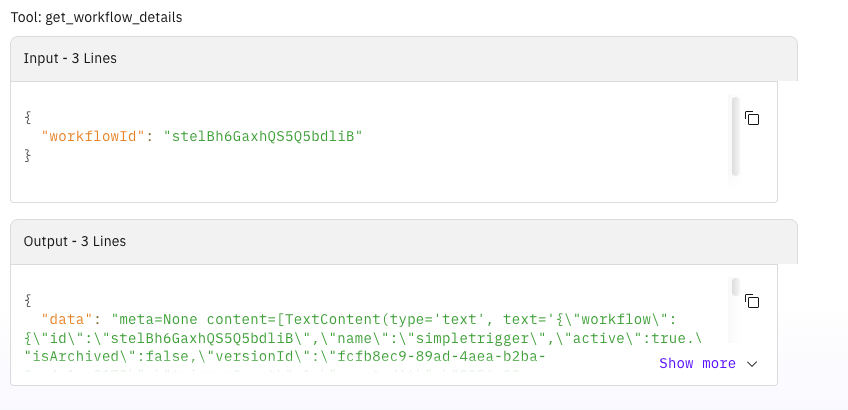
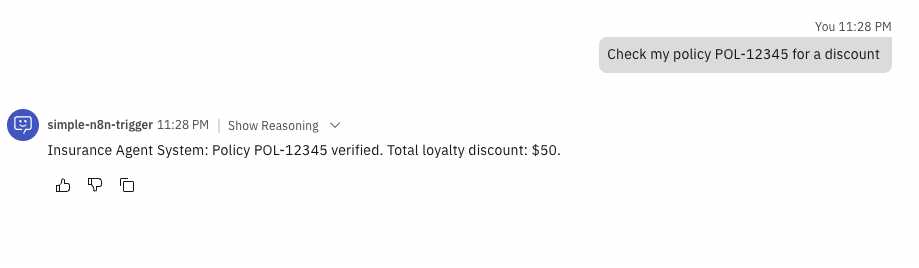
While the logic is “Hello World,” the architecture is ready for larger workflows. In a real enterprise setting, you would for example simply swap the “Code Node” to a PostgreSQL or Salesforce node. The way IBM watsonx Orchestrate calls the tool and the way n8n returns the output string remains exactly the same. It is a scalable blueprint for different tasks, from checking claim statuses to updating contact information.
Conclusion
As we have seen through this scenario, the true value of The Architecture of Efficiency lies in its balance. This synergy allows businesses to harness the adaptive reasoning of agents while grounding them in the absolute precision of a workflow. This entry-level experiment is only the beginning; there is a vast landscape of use cases you can implement using this combined superpower, from intelligent claims processing, individual policy management and customer support that can take actions.
In the end, this architecture proves that a business doesn’t have to choose between “smart” and “stable.” Pairing AI Agents and Workflows does more than just automate tasks—it re-engineers the very core of how a business operates without the need to touch or migrate existing (and already running) workflows. This is the new standard for the modern, agentic enterprise.
💬 Comments or suggestions? I’d love to hear from you! You can leave a comment on LinkedIn, send me a direct message or connect with me, or use the contact form on my blog. I look forward to hearing your story!
💡Liked what you read? Subscribe to my blog and get new posts delivered straight to your inbox – so you never miss what’s next.