

Building on one of my previous posts – where I noted that the real “North Star” for modern operations is the combination of reliable, deterministic business workflows with the fluid flexibility of AI agents – my colleague David Kreismann and I have developed a demo to showcase the combined power of both.
The use case
The scenario covers an HR scenario in three stages: application submission, HR review, and the final assessment and decision-making by the business unit.
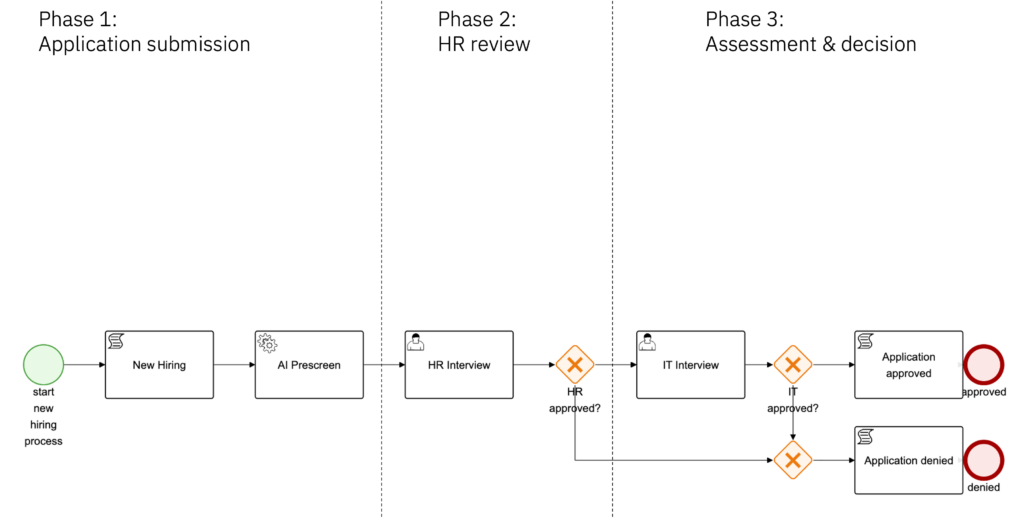
Phase 1 kicks off with two candidates applying for open roles:
- Charles McTurland as Software Engineer
- Anna Sterling as IT Manager
Switching the view, we see one instance for each applicant: Charles McTurland and Anna Sterling. Notice how the Application AI agent successfully extracted all key information from their uploaded CVs. Details like name, email, phone, and skills are now stored as variables within the respective process instance. The timeline shows, that the candidates are now ready for the HR review.
Moving into Phase 2: the HR review. Following Phase 1, the applications – or process instances – have been immediately prepared for the next stage. Here, a recruiter reviews the new submissions. In addition to a dashboard, an AI agent is available to query all IT-related applications from the last 24 hours. The result lists both candidates and their profiles, allowing the recruiter to approve them for the business unit (IT) interview.
Looking at the workflow, we can see that both candidates have been approved and are now qualified for the business unit interview.
Moving into Phase 3, a business unit lead, such as a first-line manager, has full visibility into all open roles and their status. Here, we see Charles and Anna appearing at the top of the list. By leveraging the AI agent, the manager can dive into candidate details and even generate a proposed interview structure tailored to the specific position.
Once the interview is complete, the manager can either approve or reject the candidate. Since both impressed with their skills and experience, they are both receiving offers to join the team.
Let’s check the workflow one last time: both process instances have now completed all phases. With the final approval granted, the processes are finalized and have disappeared from the active workflow view.
The technical architecture
To understand how this seamless synergy is achieved, it’s essential to examine the architectural framework. The system is built on a robust core that integrates business logic with AI agents, as illustrated in this overview:
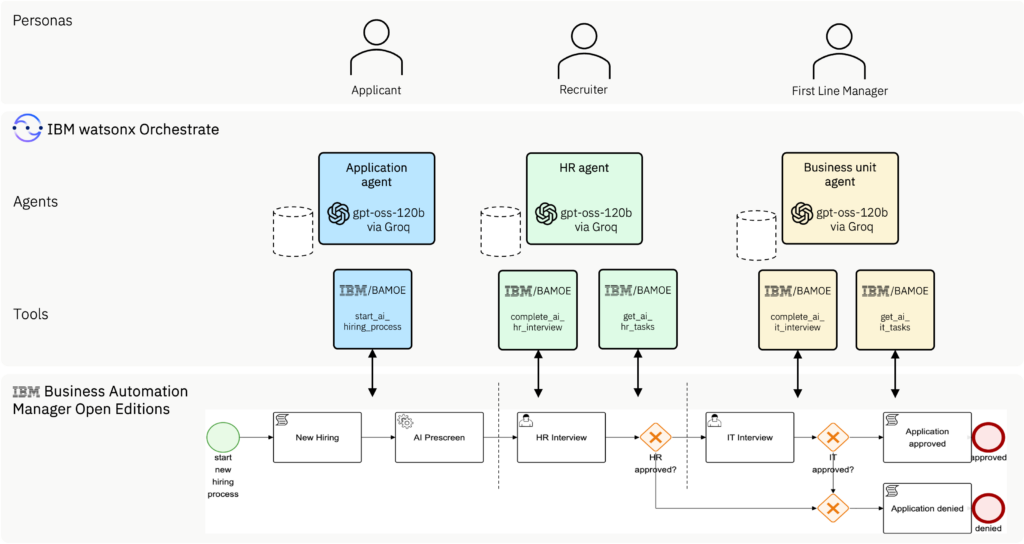
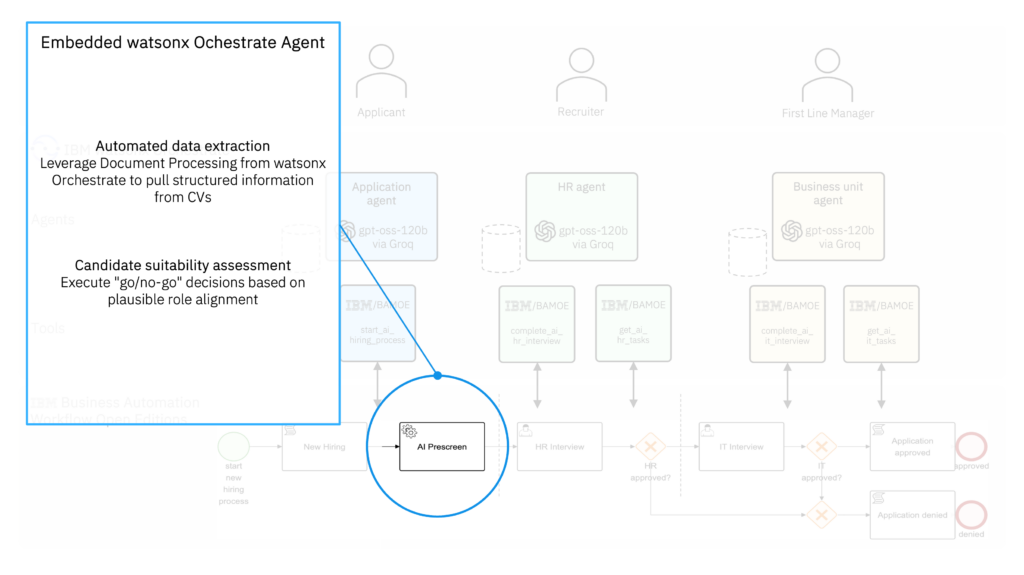
IBM watsonx Orchestrate serves as the Agentic AI platform, with the workflow implemented using IBM Business Automation Manager Open Editions. At every stage of the process, all stakeholders – from applicants and recruiters to first-line managers – utilize AI agents. These agents use various tools to execute specific tasks, such as querying an applicant’s status or approving and rejecting candidates. A core component is the AI prescreen step within the applicant onboarding process, which utilizes an embedded watsonx Orchestrate agent to:
- Streamline data capture: Utilizing watsonx Orchestrate to parse and extract key information from resumes.
- Screen for suitability: Executing automated initial decisions based on how well a candidate’s background aligns with the job profile.
Stronger together – The synergy
To bring it all together, I’ve summarized some practical takeaways and lessons learned.
Modernization over migration
Enhance, don’t replace
- Acknowledge that core business processes built over decades cannot easily be switched to “Agentic” overnight – nor is there often a strategic desire to do so.
- Success lies in finding where AI complements existing reliability.
- Avoid any risky “rip-and-replace” migrations. Deploy Agentic AI where it provides the most friction-less value without disrupting the core engine.
- Target high-effort post-processing tasks – especially those involving heavy manual rework or unstructured language and data.
Governance & scalability
- Use watsonx Orchestrate as the agentic framework for Business Automation to manage the lifecycle of agents to:
- Avoid agent sprawl & shadow AI
- Get Observability across all agents
Managing mindsets to find the right entry point
- Agentic: Managing the problem probabilistically
- Workflow: Making the problem deterministic
Organizational alignment: Bridge the gap between the "Business Automation" owners and the "AI" groups to ensure a unified architectural strategy. Sometimes a lack of trust and lack of knowledge regarding the counterpart's technology is a major barrier.
Balancing logic and agency
- Rigid workflows: Stay traditional where logic is clear and rules are fixed.
- Agentic flexibility: Deploy agents where workflows become too “situational“ or rigid for traditional logic to handle effectively.
- The language bridge: Use agents to solve the „NLU gap“ – converting complex human language into structured data that existing workflows can then process.
- No „one-size-fits-all“: There are multiple ways to design a goal-oriented flow; the objective is to find the balance between a structured path (compliance/safety) and agentic flexibility (speed/adaptability).
💬 Comments or suggestions? Send me a direct message on LinkedIn or connect with me. I look forward to hearing from you!
💡Liked what you read? Subscribe to my blog and get new posts delivered straight to your inbox.