

This is part one of a two-part series. In this first post, I will introduce an insurance use case from a business perspective, and in the second part, I will dive into the technical details.
A while back, I already explored a case related to this industry to see how AI could support claims adjusters. My focus was on reducing backlogs, looking at the process primarily from the policyholder’s perspective. The goal was to easily provide customers with information, such as their coverage details and whether a specific claim is covered or not. I also implemented a semi-automated claim-filing process, which immediately routed new claims to a claims adjuster’s dashboard for further processing.
In this new scenario, I took a closer look at the latter perspective with the help of AI. The fictional use case focuses once again on intelligent claims handling. This time, however, the policyholder, John Miller, has fraudulent intentions. Claims adjuster Elena Rodriguez from SecureLife Insurance uses AI support to thoroughly investigate the case and receive actionable recommendations for the next steps. Let’s walk through a recent incident to see how she uses AI technology to handle John’s claim and detect potential fraud.
Note: This case study uses entirely synthetic data and fictional entities; any resemblance to real-world organizations or individuals is purely coincidental. All images used to illustrate this use case were AI-generated using Google Gemini.
John’s Story: The Lie
Let’s set the stage: John, a policyholder with SecureLife Insurance, accidentally scrapes his car against a concrete pillar in a parking garage. He is entirely at fault for the damage. Under his current policy, an at-fault accident comes with a €1,000 deductible. However, there is a tempting caveat – if the damage had been caused by a third-party hit-and-run, his out-of-pocket cost would be €0.
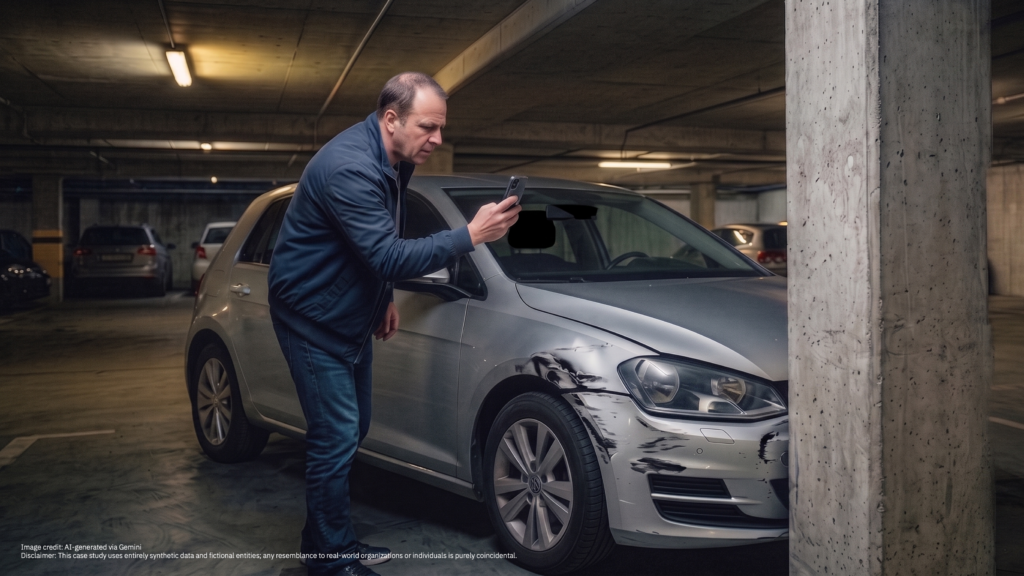
When it comes to file his claim, John decides to take advantage of this loophole. Instead of owning up to the parking garage mishap, he submits a completely fabricated story, claiming that an unknown SUV scraped his car and immediately fled the scene.
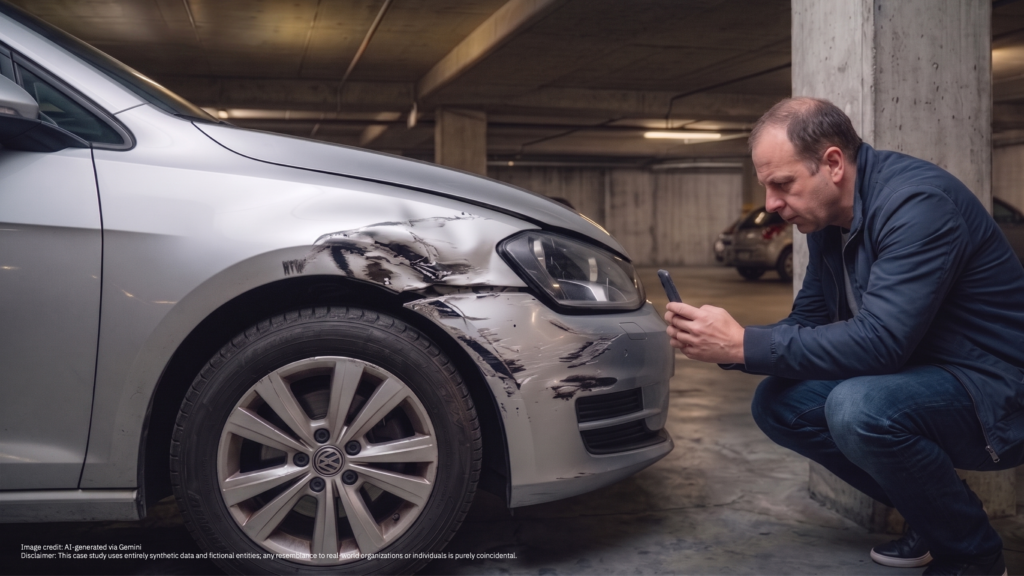
To set this plan in motion, John turns to the SecureLife mobile app. The video below demonstrates the initial step of the use case: the digital first notice of loss (FNOL).
Watch how the scenario unfolds:
- The lie in action: Notice the specific details John inputs to build his fake hit-and-run narrative.
- Seamless submission: See how the customer-facing app captures the initial data and uploads the photo evidence.
- The silent trigger: Behind the scenes is where the intelligent claims handling AI architecture will soon take over.
Meet Elena: The Adjuster’s View

With the claim officially submitted, the perspective shifts from the policyholder’s smartphone to the SecureLife back office. Now, Elena Rodriguez, a seasoned claims adjuster at SecureLife Insurance, takes over. Her task is to review the initial First Notice of Loss and determine the legitimacy of John’s story. But Elena isn’t investigating this alone. In this intelligent claims handling scenario, she is supported by an AI system designed to flag inconsistencies, analyze the evidence, and guide her through the complex process of uncovering the truth. To see exactly how this human-AI collaboration could work in practice, let’s step into the shoes of Elena.
Elena sees the newly submitted claim from policyholder John Miller on here dashboard landing page. At first glance, it’s a standard incident, but the system’s AI has already flagged it as Medium Risk during the submission process.
Initial risk classification
She opens the claim in a detailed view to review the fraud assessment. Here, Elena can read the AI model’s reasoning for this classification, which compares the image analysis against the policyholder’s written description. The AI concludes that the claim is moderately inconsistent. Its reasoning explicitly states: “The image analysis reveals no foreign paint transfer or other vehicle-specific residue” and notes that the damage would “be consistent with striking a fixed object such as a garage column”. Based strictly on the visual evidence – without relying on any additional data – the image analysis points to a collision with a fixed object.
Reviewing the conversation history
Next, she checks the conversation log from John’s chat during the initial claim submission. In his statement, he describes the incident: “I was driving slowly down the ramp in the parking garage when a dark SUV came flying around the corner on the wrong side. It swiped my front-left corner and just kept going. I had to stop because I was so shaken up”. He also added a note confirming: “No injuries”.
Examining the Image Analysis
There is a dedicated section containing the actual uploaded photo alongside the detailed image analysis generated by AI. Elena can view the image and read through the AI’s breakdown, which specifically describes the extent of the damage to the fender and the front bumper.
Detailed cost estimate
Next is a breakdown of the calculated costs. Based on the image analysis, the AI provides a comprehensive damage assessment. It identifies exactly which components and areas are affected, details the specific type of damage, outlines the necessary repairs or replacement parts, and expected costs.
The AI investigation agent
This step is the core of the intelligent claims handling process. Through an interactive interface, Elena can chat directly with a specialized AI agent, asking targeted questions to dig deeper into the case. By engaging the agent to analyze the claim details and underlying evidence, she transforms the AI from a standard tool into an active, conversational co-pilot.
First, Elena asks the agent to
Check the related policy for telematics coverage
The AI agent immediately retrieves and displays the associated policy. Elena is presented with a clear overview of all relevant policy data, including the policy number, type, status, and start date, alongside essential financial components like the deductible and coverage amounts. Crucially, the system highlights active benefits, specifically noting Safe-Mile Telematics. The answer also outlines comprehensive vehicle details – such as the make, model, year, license plate, and VIN (Vehicle Identification Number). The interaction concludes with the AI agent explicitly confirming that the vehicle’s telematics data is available and can be loaded on demand for further investigation.
Elena then instructs the AI to:
Analyze the telematics data to see if it aligns with the reported damage
Because raw telematics involve complex technical metrics, the AI processes and presents the data in a highly readable format, breaking it down into distinct categories:
- Impact signature: The physical forces acting upon the vehicle suggest a vehicle-to-vehicle collision.
- Rigid-object flag: Set to “no,” which favors John’s description.
- Vehicle state before impact: The data shows the car was in motion (not stationary), further supporting John’s narrative.
- GPS location: The coordinates confirm the vehicle was indeed inside the underground parking structure.
In addition, the AI agent presents Elena with a checklist of potential fraud indicators based purely on these physical measurements. A “stationary vehicle hit” is ruled out since the car was moving. Being “hit by another vehicle” is deemed plausible, while an impact with a “rigid object” is largely excluded. Because these indicators are derived strictly from the isolated telematics data – without drawing on further context – they actually back up John’s story. The telematics data alone does not confirm fraudulent behavior.
Elena deduces that the customer might have felt confident submitting the claim, likely knowing his telematics data would appear clean. In intelligent claims handling, the burden of proof lies with the insurer; without definitive proof of fraud, John is presumed innocent. However, Elena isn’t giving up so easily.
She correlates some more data points, asking the AI agent
Have there been similar claims in the past?
The agent reveals that, indeed, a similar claim was reported in the past. It was successfully processed from John’s perspective at the time, but was later flagged as fault-shifting. The current claim exhibits a similar pattern. However, the core discrepancy remains: the telemetry data supports a vehicle-to-vehicle scenario, not a fixed impact with a concrete pillar or something similar. Because of this, the system instructs Elena to take a closer look at the historical claim.
Finally, Elena asks the AI agent:
What is the internal guidance for proceeding with this claim?
Based on the correlated evidence, the system instructs her to escalate the case to the Special Investigation Unit (SIU) to verify the complete situational picture. The SIU’s mandate will be to determine if the crash could indeed have been a fixed-object impact despite the telematics, to investigate the missing paint transfer, and to scrutinize the vague narrative and lack of supporting documentation, such as a police report. These discrepancies, combined with the similar historical case, provide strong grounds for suspecting the policyholder. By aggregating all these data points – the conflicting findings from the AI image analysis, the historical fault-shifting pattern, and the missing documentation – the system ultimately generates an aggregated fraud confidence score of over 90%.
Ultimately, this workflow demonstrates that while AI is strong at surfacing data, analyzing images, and reading sensors, it is the adjuster’s intuition and experience (expanded human context) – empowered by intelligent agents – that knows exactly which questions to ask to uncover the truth.
As mentioned at the beginning, this is part one of a two-part series. In the second part, I will take a closer look at the technical implementation of this use case.