

Introduction
In this blog post, I collected my thoughts and hands-on experiences with building an event-driven agentic AI architecture. To make this tangible, I’ve built a reference example around Industrial IoT (IIoT) zone safety monitoring.
IIoT is often perceived as a “solved” technology stack – everyone has sensors, broker queues, and dashboards. But the actual pain point isn’t getting sensor data; it’s contextual decision-making. Enriching established IIoT pipelines with agentic AI turns passive context-blind data streams into active reasoning systems.
Imagine a factory floor split into two entirely contrasting environments.
On one side: a CNC machining zone. It runs warm, it’s loud, and it is never clean. Metal dust drifts, coolant mist hangs in the air, and a background CO trace from tramp oil and hydraulic heating is just a fact of life. When something goes wrong, like a dull cutting tool or a ruptured coolant line, the sensor reaction is sudden and extreme: temperature, CO, and PM2.5 levels can all skyrocket in a matter of seconds.
On the other side: an electronics assembly area. Here, the temperature is strictly locked to 21 °C, and humidity is held between 50% and 55% to protect against electrostatic discharge (ESD). Thanks to continuously running benchtop fume extractors, airborne particulates are virtually non-existent. Failures in this zone are much more subtle – a humidifier quietly failing or CO₂ steadily creeping up as airflow drops – but no less consequential for the sensitive circuit boards being assembled.
Two zones, two completely different risk profiles, sharing the same factory floor. Using blanket alarm thresholds and a single response playbook across both simply isn’t effective. Still, conventional monitoring systems often tend to rely on that kind of one-size-fits-all approach.
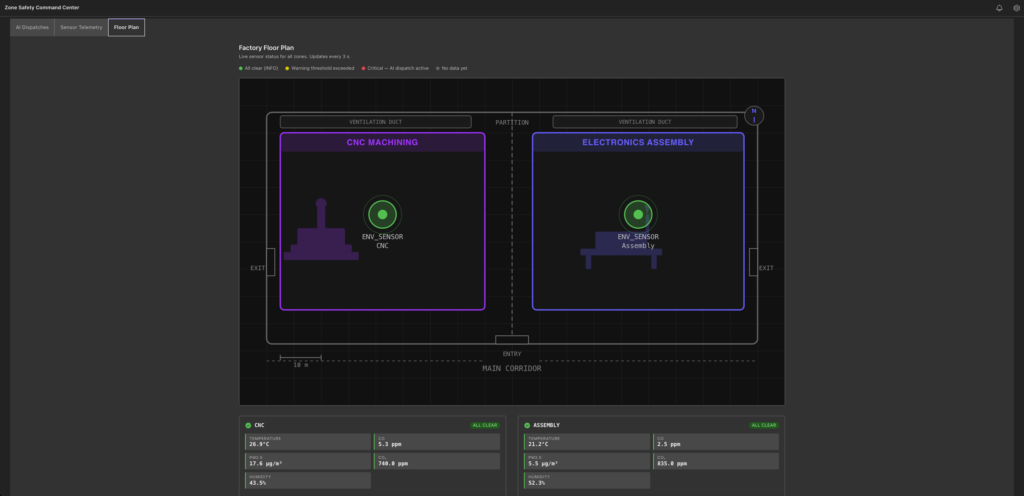
This post walks through production-grade reference architecture for event-driven AI agent pipelines applied to industrial zone safety monitoring. It monitors both zones simultaneously: taking synthetic live sensor data from each area, processing and smoothing it in real time with Apache Kafka & Flink, and automatically dispatching a watsonx Orchestrate AI agent to dynamically reason through the incident, build a tailored mitigation plan, and dispatch the right work order to the right team.
The Core Challenge: Alarm Flooding & Industrial Standards
Industrial facilities generate vast streams of sensor data. In this setup, two zones push five core signals – temperature, humidity, CO₂, CO, and PM2.5 – every five seconds. That is 120 data points per minute flowing across the shop floor.
Most of the time, everything sits in a safe baseline. But when a thermal or mechanical failure occurs, physical signals do not just jump instantly to a final state; they drift, fluctuate, and cascade over several minutes.
This brings out the primary weakness of threshold-based systems: alarm flooding.
What is Alarm Flooding?
For example, if a CNC spindle bearing overheats over the course of four minutes, a basic rule evaluating raw sensor data every five seconds will trigger up to 48 separate temperature alerts for the exact same underlying event.
When operators are bombarded with hundreds of repetitive or transient notifications, alarm fatigue sets in. Critical signals get ignored, muted, or acknowledged without investigation.
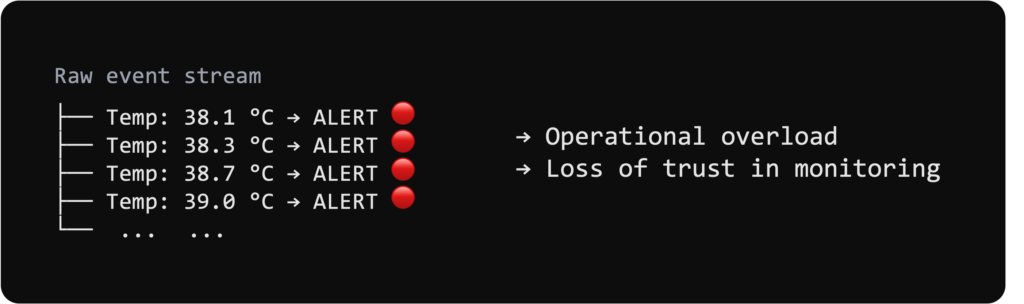
To combat this, industrial automation relies on standards like ISA-18.2 and IEC 62682 (Management of Alarm Systems for the Process Industries). These standards define formal patterns to manage alarm lifecycles:
- Alarm rationalisation: Ensuring every alert corresponds to a true operational condition requiring human action.
- Deadband filtering & smoothing: Requiring a signal to cross and remain beyond a threshold over time, rather than tripping on momentary spikes.
- Re-alarm suppression timers: Preventing a sustained alarm condition from re-triggering notifications continuously while maintenance is already responding.
If you naively wire a raw sensor stream directly into a Large Language Model (LLM), you export the exact same alarm flooding problem to your AI layer:
Bridging Industrial Engineering and AI
- Token burn & high latency: Calling an LLM 12 times a minute for the same drifting temperature spike drains local computing power and creates useless agent dispatches.
- False positives: Transient spikes (like a 5-second puff of dust) trigger unnecessary agent reasoning steps.
The key insight of this reference architecture is embedding proven alarm management frameworks (like ISA-18.2 and IEC 62682) directly into the stream processing layer before handing qualified, high-signal alerts to an AI agent. Flink handles the time-series physics; the LLM handles the contextual reasoning.
The 5-Layer Architecture Overview
To solve alarm flooding while delivering context-aware dispatching, the system is structured into five distinct layers. Each layer has a single, strictly bounded responsibility.
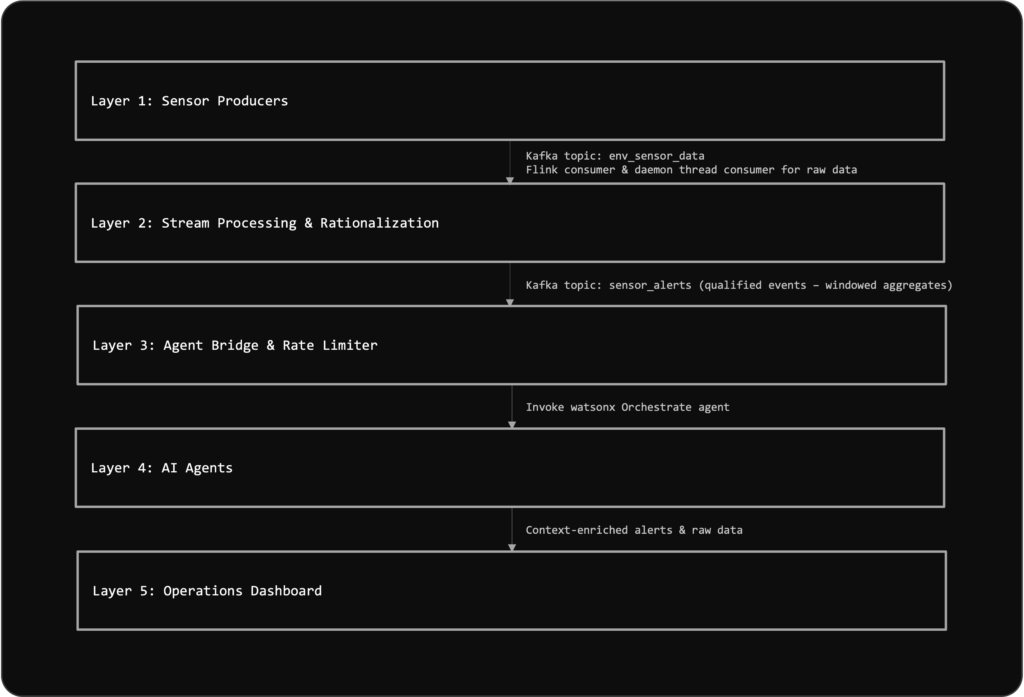
Layer-by-Layer Execution Flow
- Layer 1: Sensor Producers (Physical Event Simulation)
- Tech stack: Python (
sensor_cnc.py,sensor_assembly.py), Apache Kafka (env_sensor_datatopic). - Core function: Simulates physical environment telemetry by publishing 5 core signals – temperature, humidity, CO₂, CO, and PM2.5 – every 5 seconds.
- Mechanism: Driven by a
SCENARIOenvironment variable to inject realistic failure signatures (e.g., tool fires, coolant leaks, ESD humidity drops) or run healthy baseline shifts.
- Tech stack: Python (
- Layer 2: Stream Processing & Rationalization (The “Token Shield”)
- Tech stack: Apache Flink (
env_sensor_data→sensor_alertstopic). - Core function: Acts as the primary suppression filter. Applies a 60-second tumbling window (12 consecutive readings) to average signals before threshold evaluation, absorbing transient single-tick noise (like a 5-second dust puff).
- Logic boundary: Evaluates zone-specific baselines (Temperature 38°C for CNC vs. 26°C for Assembly), life-safety limits (CO > 15ppm, PM2.5 > 35µg/m³), and ESD risk (Humidity < 30%).
- Note: Flink decides IF an event warrants attention; it does not reason about what it means.
- Tech stack: Apache Flink (
- Layer 3: Agent Bridge & Rate Limiter (SCADA Cooldown & Bifurcation)
- Tech stack: Python (
agent_bridge.py), dual-threaded Kafka consumer. - Alert loop: Consumes
sensor_alertsand enforces a 180-second per-sensor cooldown timer (aligned with ISA-18.2 / IEC 62682 re-alarm suppression standards) before invoking the AI backend. - Telemetry loop (daemon thread): Concurrently consumes raw 5-second ticks directly from
env_sensor_dataand writes them unfiltered tosensor_log.jsonfor live UI charts. - Design Boundary: Isolates high-frequency charting data from rate-limited AI dispatch streams.
- Tech stack: Python (
- Layer 4: AI Agent Layer (Contextual Reasoning & Dynamic Dispatch)
- Tech stack: watsonx Orchestrate Agent, YAML-configured, LLM-backed.
- Execution pattern: Evaluates qualified alerts through a 6-step deterministic tool chain before generating a response:
check_zone_ambient_conditions: Quantifies signal deviations against zone-specific baselines.get_alert_history: Readsalert_history.jsonto calculate trajectory trends (STABLE, ESCALATING, RECOVERING) across past dispatches.get_prior_dispatches: Retrieves prior agent-written text to prevent repetitive routing loops and escalate unresolved issues.get_zone_equipment_info: Pulls exact hardware identifiers (e.g., valves, LEV fan refs, breakers) for actionable work orders.prepare_dispatch_payload: Formats the information into a tagged JSON payload (DISPATCH_PAYLOAD::{...}) answer.
- Design Boundary: The agent executes inside the Orchestrate runtime without filesystem access; the bridge parses the tagged payload and writes it to
dashboard_log.json.
- Layer 5: Operations Dashboard (Real-Time Command & Control)
- Tech stack: React (Carbon Design System v11), Express, SVG rendering.
- Three dedicated views:
- AI dispatches tab: Displays real-time, AI-generated maintenance alerts and technician instructions produced by the AI Agent Layer. Each message includes technician action recommended by the AI, the full LLM reasoning, and the raw sensor assessment that triggered the dispatch.
- Sensor telemetry tab: Polls
dashboard_log.jsonevery 3 seconds to surface AI-dispatched messages in real time. When a critical scenario fires, the tab dynamically renders a critical alert banner alongside the affected zone and department breakdown grid (routing to EHS, Mechanics, Electrical, or Facilities). Each dispatch card is individually expandable to reveal the full LLM reasoning trace, physical failure diagnosis, granular sensor assessment, and next steps to take. - Interactive floor plan: A live SVG map deriving dual-state node statuses – raw warning thresholds from
sensor_log.jsonand AI critical dispatches fromdashboard_log.json.
Streaming Intelligence Meets Agentic Reasoning
The real power of the layered architecture lies in how the Streaming Layer (yellow), the Agentic Layer (green) and the Human Layer (blue) interact. Together, they form an execution engine driven by a continuous loop as outlined in the image below.
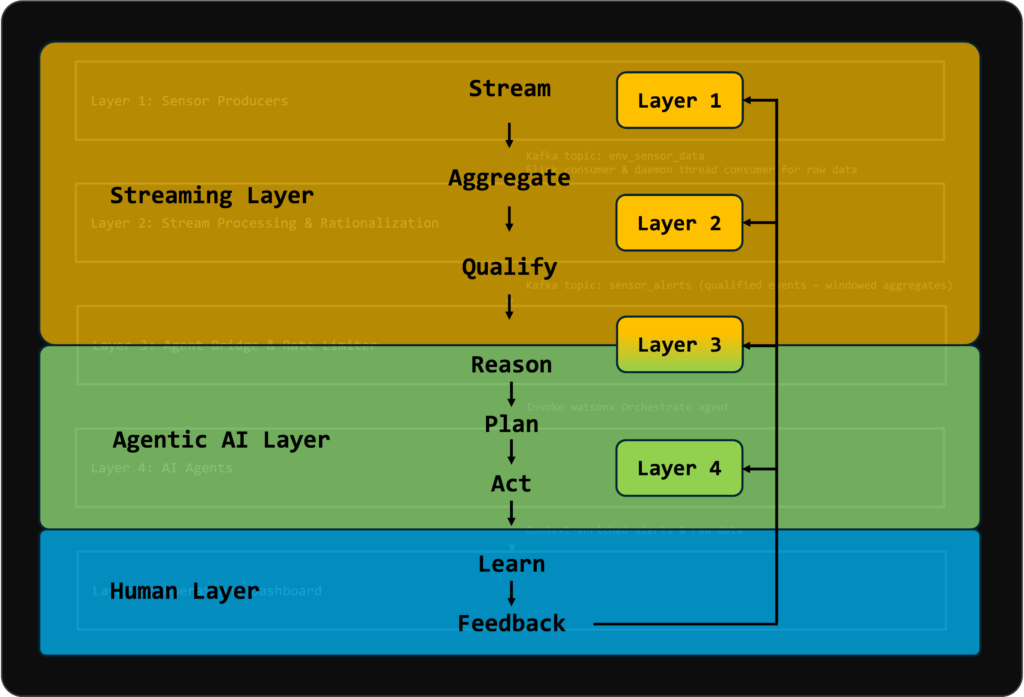
Note: While shown here as a linear sequence, Reason → Plan → Act actually functions as an iterative agent loop over continuous observations – evaluating whether a task is complete to output a final answer or proceeding to the next iteration. The same applies to learning and feedback, which operate as a continuous loop in themselves before any human feedback is actually passed back to the respective layers.
What Each Layer Adds: From Isolated Data Points to Context-Aware Action
- The Streaming Layer (Apache Kafka & Flink)
- Real-time event handling: Ingests high-throughput event streams, filters out noise, and calculates rolling window aggregations with minimal latency.
- Pattern detection: Continuously evaluates stream state to detect anomalies, threshold breaches, or trend shifts across multiple sensors simultaneously.
- The Agentic Layer (watsonx Orchestrate)
- Context & domain grounding: Injects the deep structural context that individual data points lack – such as machine hall blueprints, ventilation duct topologies, CNC vs. assembly station specs, and part-level operating tolerances.
- Targeted AI dispatches: Instead of firing generic, noisy alarms, the agent evaluates the anomaly against its knowledge of the surrounding environment to generate precision-targeted dispatches and recommended next-best actions following a react – plan – act – observe loop.
Closing the Loop: Multi-Layer Feedback Mechanisms
For this architecture to remain effective, feedback cannot be a one-way street. A static system inevitably drifts from the realities of a dynamic operational environment. Maintaining alignment requires continuous recalibration driven by a hierarchy of expanding context. At the base, the streaming layer processes concise, low-context time-series data. The agentic layer elevates this by synthesizing broader operational context and generating reasoning plans. Finally, the human layer introduces the most comprehensive context of all: hands-on engineering experience, shop-floor quirks, and complex organizational dependencies. Domain experts act as the final evaluation authority, validating agent-driven outcomes and routing controlled, high-order feedback back down into both – the agentic and streaming – layers.
- Layer 1: Integrating new sensors or modified physical streams requires feedback-driven adjustments to topic topologies to correctly merge or re-route data paths into the pipeline.
- Layer 2 & 3 At this layer, processing thresholds must be adjusted to account for natural machine wear, altered operating baselines, or updated regulatory compliance limits.
- Layer 4: Surrounding environmental and operational changes – such as a relocated ventilation unit, revised maintenance schedules, shift schedules and staff availability, or updated documentation for existing and new machines are fed back into the agent’s operational context to ensure its decisions remain grounded in real-world conditions.
Autonomous Event-Driven Triggers
AI agents must not sit idle waiting for manual human prompts. In this architecture, agents are automatically triggered by aggregated stream events. When Flink detects a complex pattern – such as correlated thermal and air quality anomalies – it immediately emits a high-level event that triggers the AI agent into action. The agent instantly reasons over the context, formulates an action plan, and dispatches targeted countermeasures to proactively avoid operational bottlenecks.
Seeing it in Action: Live Demos Across 3 Shop-Floor Scenarios
To test this architecture under realistic shop-floor conditions, I built a set of interactive scenarios. Each scenario simulates a unique physical signature across the sensor streams (temperature, humidity, CO₂, CO, PM2.5).
To see how the streaming layer (Apache Kafka & Flink) and the agentic layer (watsonx Orchestrate) work in tandem, let’s look at three contrasting scenarios. For better readability in the charts, unaffected sensors remain in normal mode.
Scenario 1: Routine Workpiece Blow-Off
Handling momentary particulate spikes without false alarms.
Flink absorbing a transient particulate spike during chip blow-off without invoking the AI layer.
- The Physical Event: In Zone A, an operator uses a compressed-air gun to blow metal shavings off a finished part. This creates a tiny, brief dust cloud. PM2.5 spikes sharply to 40 µg/m³ for just 5 seconds, then immediately drops back to normal. All other metrics (temperature, CO₂, humidity) remain completely flat.
- Why Traditional IIoT Fails: Standard threshold monitoring fires a hard alarm the moment PM2.5 crosses 35 µg/m³. On a busy shift, air guns are pulled dozens of times, bombarding operators with useless false alerts until everyone starts ignoring the system.
- The Smart Architecture Response: Instead of passing raw telemetry straight to an alert system or an expensive LLM, Apache Flink calculates a rolling 60-second tumbling window. It averages that single 5-second spike (40 µg/m³) with 11 clean baseline readings (~15-20 µg/m³). The window average calculates to ~19.8 µg/m³ – sitting safely below the threshold.
- Key Takeaway: Heavy lifting happens at the stream layer. Flink suppresses transient noise locally – resulting in zero false alarms, zero API calls to the AI agent, and zero wasted tokens.
Scenario 2: Tool Binding & Incipient Oil Fire
Detecting cascading multi-sensor signatures during machine failure.
End-to-end execution of tool binding fire alert – from raw Kafka sensor data to multi-signal AI reasoning and dynamic EHS dispatch through the watsonx Orchestrate agent.
- The Physical Event: A CNC cutting tool jams inside a workpiece. Friction rapidly heats the metal, vaporizing coolant fluid and igniting surrounding oil mist into a localized fire.
- The Telemetry Signature: Unlike a quick burst of air, this incident unfolds across multiple sensors at different speeds:
- PM2.5 jumps to ~60 µg/m³ within 10 seconds as oil mist fills the air.
- CO climbs steadily to ~25 ppm as micro-combustion begins.
- Temperature lags behind due to machine thermal mass, creeping up to ~45 °C over 60 seconds.
- Why Traditional IIoT Fails: Static rules treat these as three isolated, uncoordinated alerts. Standard rules can’t distinguish an active oil fire from a routine coolant leak (which also raises humidity, but leaves CO at zero).
- The Smart Architecture Response: Flink recognizes a sustained multi-signal anomaly and passes the clean event window to watsonx Orchestrate. The AI agent correlates all three signals simultaneously. Recognizing the signature of burning oil mist, it automatically builds a context-rich incident report and dispatches a CRITICAL EHS work order with emergency suppression protocols attached.
- Key Takeaway: Flink detects that something abnormal is happening across streams, while watsonx Orchestrate reasons why it’s happening and executes the tailored emergency playbook.
Scenario 3: Silent Humidifier Failure
Catching invisible humidity drops that threaten microchip quality.
- The Physical Event: In Zone B (Electronics Assembly), an industrial steam humidifier silently trips during a dry winter day. There is no fire, no smoke, and no temperature change – just an invisible drop in room moisture. In a short time frame, relative humidity decays from 52% down to 21%.
- Why Traditional IIoT Fails: Conventional environmental safety systems focus on human hazards (overheating, smoke, toxic gas). Because dry air poses zero physical danger to human operators, standard EHS safety systems stay completely silent.
- The Smart Architecture Response: Flink detects the humidity threshold breach and triggers the agent. watsonx Orchestrate checks the event and applies zone-specific domain knowledge: humidity below 30% violates IPC-A-610 manufacturing standards. Dry air drastically increases Electrostatic Discharge (ESD) risk, which can silently destroy microchips during assembly. The agent immediately issues a WARNING work order to Facilities to pause sensitive production until humidity stabilizes.
- Key Takeaway: Safety isn’t just about avoiding fires; it’s about protecting product integrity. By pairing zone context with agentic AI, the system catches silent quality risks that traditional safety rules completely overlook.
Conclusion & Key Takeaways
Connecting high-frequency industrial sensor data to AI agents requires a strict separation of concerns. While AI Agents excel at non-deterministic reasoning, root-cause investigation, and dynamic workflow execution, they should not be burdened with raw time-series filtering or threshold evaluation.
By inserting a “Token Shield” stream-processing layer and adhering to established industrial standards (ISA-18.2 and IEC 62682), this architecture achieves four vital outcomes:
- Event-driven autonomous triggering: Moves AI beyond passive, prompt-driven chatbots. The stream processing pipeline actively invokes the agent only when a qualified incident occurs – eliminating manual investigation steps and notifying human operators directly when intervention is needed.
- Cost & efficiency optimization: Filtering out transient noise and signal drift before reaching the AI layer prevents unnecessary LLM invocations and token waste.
- High-context agent reasoning: The AI agent receives only qualified, rationalized incidents enriched with baseline deltas, allowing it to generate accurate, zone-specific mitigation plans.
- Reduced alarm fatigue: Enforcing re-alarm cooldowns and localized suppression keeps operators focused on actionable maintenance work orders rather than alert storms.
Whether applied to manufacturing floors, energy grids, insurance workflows, or enterprise IT operations, this layered architecture provides a transferable design pattern for building real-time, event-driven AI systems across diverse industrial domains – from physical to digital.